Next Year in the White House
For the first time, picture-book readers can enjoy the story of the first official White House seder. PJ Library helped bring the book to life.
By Rachel Zaimont, Managing Editor
This story appeared in the summer 2025 issue of PROOF, a PJ Library magazine.
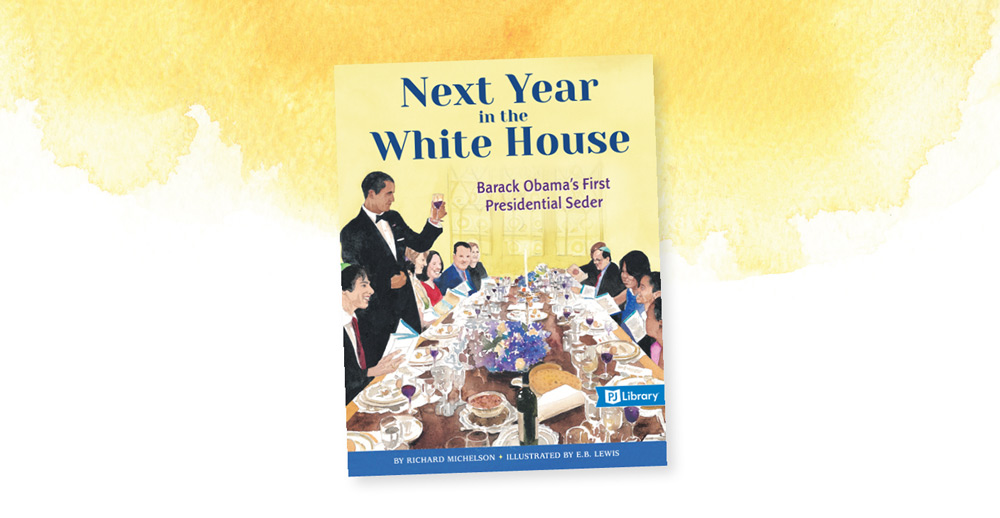
Next Year in the White House was copublished by PJ Publishing and Crown Books for Young Readers, an imprint of Random House Children’s Books.
In 2009, former President Barack Obama made history when he hosted the first official Passover seder held at the White House — a tradition he continued every year he was in office. But few at the time knew this momentous event traced its origin to an unlikely place: a drab hotel basement on the campaign trail one year earlier.
It was the first night of Passover in April 2008, and campaign staff members Eric Lesser, Herbie Ziskend, and Arun Chaudhary couldn’t go home to their families. They had just sat down for a simple seder when a surprise guest asked to join: then-Senator Obama. They all read from the Haggadah and found commonality in the saga of liberation and faith. After everyone raised their glasses and uttered the ritual Passover toast, “Next year in Jerusalem,” Obama chimed in, “Next year in the White House!”
The tale might have remained a brief historical footnote. Instead, thanks to champions of the story including Lesser and PJ Library founder Harold Grinspoon, the anecdote evolved into Next Year in the White House — a rich nonfiction narrative of hope, Jewish ritual, and inclusion. The story was copublished by PJ Library and Crown Books for Young Readers, an imprint of Random House Children’s Books, earlier this year. Sent to families of 8-year-olds in March and widely available for purchase, the book was lauded in a Kirkus starred review as “essential reading for all children — and adults — who hope for freedom for all.”
How did a story about adult topics — politics, race, and religion — become a page-turner for children? It took an all-star team, including award-winning children’s book author Richard Michelson and celebrated illustrator E.B. Lewis. And it took perseverance from those who believed in the tale.
“We loved telling the story to our friends and family,” says Lesser, now a former White House aide and Massachusetts state senator and one of the main characters in the book. “There was something so wholesome about it. It’s a story of people honoring their unique identity, sharing it with others, and creating a new story as a result of that engagement.”
When Harold Grinspoon heard the story, he felt it had the makings of a picture-book classic. Thanks to Michelson’s deft rendering, the text evokes accessible themes for all ages: taking part in a cause, working for something you believe in, and nurturing hope in the face of daunting odds.
Plus, “the Passover seder is a core Jewish storytelling ritual,” says Alex Zablotsky, PJ Library’s executive director. “The fact that these campaign staffers committed to that ritual and inspired the first White House seder — it’s a positive representation of Jewish life in America that I hope subscribers can view with pride.”
Random House Children’s Books is “proud to publish this look at a historic celebration from our country’s recent past,” says Kelly Delaney, senior editor of Crown Books for Young Readers. “It’s important for kids to see that history is being made all the time, and it’s never too late to invite more people to sit at your table.”
The book marks the first time PJ Publishing has collaborated with a major trade publisher, meaning this title is now on bookstore and library shelves for all to read — Jewish or not. Engaging appendices at the back of the book provide context about Black history and the Exodus story, along with Passover and the meaning of the seder.
“The fact that descendants of two groups who experienced slavery could share a meal in the most important house in the country is an incredible, amazing thing of hope,” says Michelson. “That’s what I want kids to get out of it — not to give up hope.”