
If you’ve ever been confused about the difference between the words Ladino and Latino, here’s a quick primer, courtesy of PJ Library author and Sephardic educator Sarah Aroeste.
Latino:
The word Latino is shorthand for the Spanish word latinoamericano and refers to people with origins in Latin America, including countries in Central America, South America, and parts of the Caribbean, where Spanish or Portuguese are spoken. This term is not the same as Hispanic, which more broadly includes people from Spanish-speaking countries outside Latin America, such as Spain. Here’s how you can understand the differences:
- A person from Mexico is both Hispanic and Latino (Spanish-speaking from Latin America)
- A person from Brazil is Latino but not Hispanic (not Spanish-speaking, but from Latin America)
- A person from Spain is Hispanic but not Latino (Spanish-speaking, but not from Latin America)
Ladino:
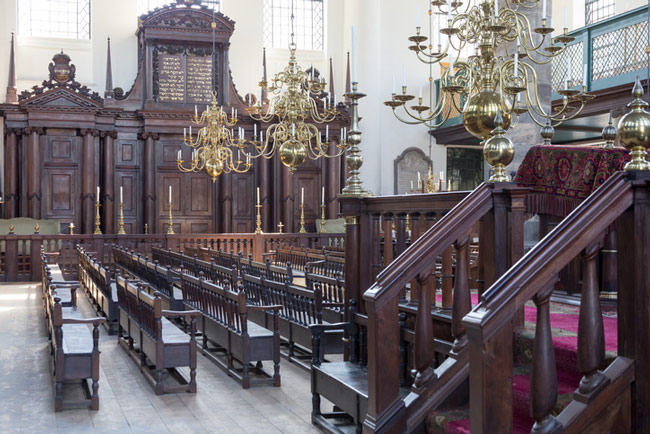 17th-century Sephardic synagogue in Amsterdam
Also commonly known as Judeo-Spanish or Judezmo, Ladino is a language developed by Jews from Spain and Portugal (who are referred to as Sephardic Jews) after their expulsion from the Iberian Peninsula beginning in 1492. Built upon the Castilian Spanish of the time, Ladino incorporated elements of other languages from countries where Jews settled as they dispersed across the Mediterranean and Ottoman Empire. Today one can hear elements of Italian, French, Hebrew, Turkish, Arabic, Greek, and more in Ladino. For nearly five centuries, until WWII, Ladino was the primary language of Eastern Mediterranean Sephardic Jews. It is still spoken today!
Here’s an even deeper look:
Those Sephardic Jews who did not disperse toward the Mediterranean after their exile but, rather, ended up settling in non-Iberian, mostly Dutch territories, such as Curaçao in the West Indies, Recife in Brazil, and even New Amsterdam (what would become New York!) did not speak Ladino. Many were descendants of conversos, those forcibly converted to Catholicism while living in the Iberian Peninsula, and so they did not flee during the subsequent expulsions. These groups eventually formed communities and formally returned to Judaism and are referred to as Spanish and Portuguese Sephardim, or Western Sephardim. Therefore, a person can be Sephardic and not have Ladino as their tradition. However, the reverse is not true. Those Jews who spoke Ladino as their mother tongue were of Sephardic origin.
About the Author
Sarah Aroeste is an award-winning singer-songwriter and children’s book author focused on bringing Sephardic culture to new generations. She has published numerous bilingual Ladino/English books for children, such as Mazal Bueno! and Uno, Dos, Tres: A Sephardic Counting Book. Her forthcoming book with PJ Publishing, Bavajadas! That’s Just Silly!, will be published in Fall 2025. Visit saraharoeste.com for more.
More
Sephardic Stories Initiative
A Quick Introduction to Ladino
Why We Chose This Book: Uno, Dos, Tres: A Sephardic Counting
September 26, 2025