November is Sephardic and Mizrahi Heritage Month, a time to celebrate Jewish communities whose traditions, songs, and cuisine come from many places around the world. Learn more about the rich history, culture, and traditions of the global Sephardic and Mizrahi communities in this primer for families.
While many commonly think of Ashkenazi and Sephardi as the former being from Eastern Europe and the latter from the Iberian peninsula, between the two there’s some overlap as well as nuanced differences. Let’s take a deep dive into the meaning behind the words Sephardic and Mizrahi.
Mizrahi
In Hebrew, the word Mizrach means “east”, Jews have lived in the Mizrach for more than 2,500 years, since the Babylonian Exile, subsequently branching out from Morocco to India. Mizrahi Jews are the descendants of families that lived in countries east of Israel, such as Iraq and Iran, or Babylon and Persia in ancient times. Jews have lived in the Mizrach for more than 2,500 years, since the Babylonian Exile. Mizrahi Jews speak many different languages, including Farsi and Judeo-Arabic, a collection of Arabic dialects spoken by Jews in several countries.
Have a listen to a Judeo-Arabic Song from Morocco
There are still Jewish people living in Mizrahi countries such as Iran, Uzbekistan, and Azerbaijan, though in the 20th century, as it became increasingly unsafe to live in those countries, the majority moved to Israel, the United States, and other places around the world.
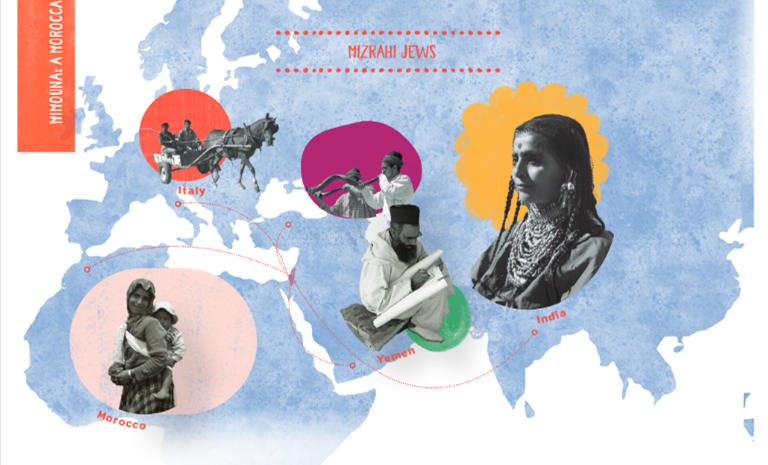 Image from PJ Library’s guide A Time to Gather
Sephardic
In Hebrew, the name for Spain is Sepharad. Sephardic Jews lived in the Iberian Peninsula for more than 1,500 years. From the 10th to 12th centuries, a time known as the Golden Era, Jews flourished there. During this period, many important Jewish texts were produced, including poetry, philosophical writings, and codes of Jewish law (Halacha) written by such great rabbis as Maimonides. Many popular Sephardic songs were written at this time, including “Ki Eshmera Shabbat,” written by Rabbi ibn Ezra in the 11th century.
Sephardic Jews living in Spain spoke Ladino, a mix of Hebrew and Spanish. Read more about Ladino here and have a listen to the classic Ladino songs “Ocho Kandelikas,” sung on Hanukkah, and “Kuando El Rey Nimrod.”
In 1492, Jewish people living in Spain were forced to leave or convert to Christianity. Some people, conversos, converted and remained practicing Jews in secret. Others moved to Morocco and other parts of North Africa, because the region is geographically close to Spain and because there were already Jewish communities there. Some moved across the Mediterranean to Greece, Turkey, Syria, and beyond. Still others went north to the Netherlands. From there, Sephardic Jews traveled to the New World, establishing communities in Brazil and Curaçao, for example. Later, Sephardic Jews emigrated to the United States. Thus, Sephardic traditions were carried not only across the Mediterranean but ultimately around the world.
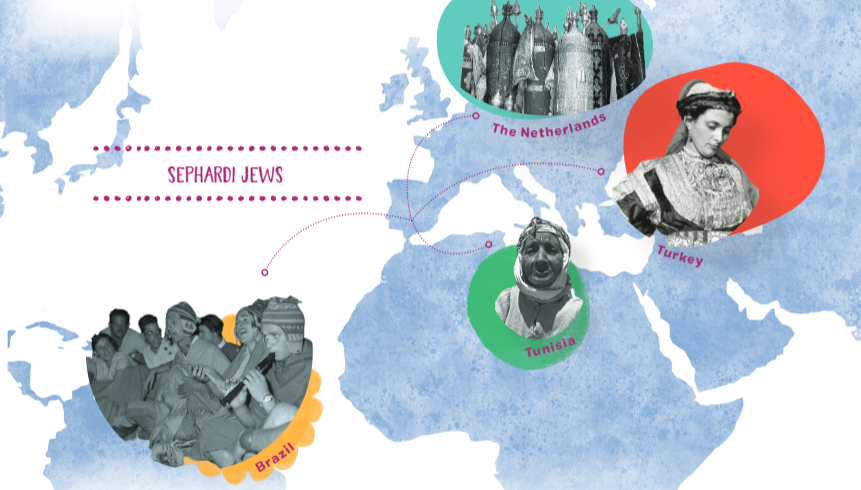 Image from PJ Library’s guide A Time to Gather
“Lecha Dodi,” the famous Shabbat song, was written by a Sephardic Jew living in the Ottoman Empire, modern-day Turkey. Have a listen!
Revivo Project’s Shabbat Medley “Machrozet Shabbat”
Why are these terms often grouped together?
So can someone be both Mizrahi and Sephardic? Yes! Just as someone can be American and Latino, some Jews are both Mizrahi and Sephardic, based on a combination of geographical roots and cultural and religious practice. In Israel, the term Mizrahi is more widely used to refer to non-Ashkenazi Jews, and outside Israel, the term Sephardic is more widely used. Connected across miles, the greater Sephardic and Mizrahi Jewish world has many rich cultures and histories to be celebrated. This month try a Sephardic or Mizrahi recipe or take a look at our PJ Sephardi-Mizrahi Heritage Month Book List.
About the Author
A senior at Columbia University, Yasmine Abouzaglo is from Texas and has Moroccan Israeli and Costa Rican Jewish roots. Yasmine is a former Sephardi House Fellow (as appointed by a program of the American Sephardi Federation) and a co-lead and founder of Hamsa, Columbia/Barnard Hillel’s Mizrahi and Sephardi Student Group. She joined PJ Library as a summer intern in 2026.
More
A Short Introduction to Mizrahi Culture
A Brief History of the Moroccan Jewish Community
Telling Sephardic and Mizrahi Stories
October 19, 2026