From Childhood to Campus and Beyond
They grew up with PJ Library. Now they’re entering young adulthood. Four alums speak about PJ Library’s lasting impact.
By Rachel Zaimont, Managing Editor
This story appeared in the summer 2026 issue of PROOF, a PJ Library magazine.
PJ Library helps families raise confident, resilient Jewish children who are connected to their Jewish identity, traditions, and values. But what happens when kids grow up? Does the PJ Library experience stay with them? Do the memories matter?
Founded in 2005, PJ Library has entered young adulthood — and so has the first generation of children who received books when they were young. We sat down with several alums and learned something gratifying: PJ Library has shaped them in profound ways. For them, PJ Library remains a point of connection among peer groups. It serves as a stepping stone to future Jewish decisions. It strengthens them as they navigate new social worlds amid challenging times. They may not receive books in the mail anymore, but the lessons inside left their mark.
Read on to meet four members of the first PJ Library generation — a generation leading involved, engaged, proudly Jewish lives.
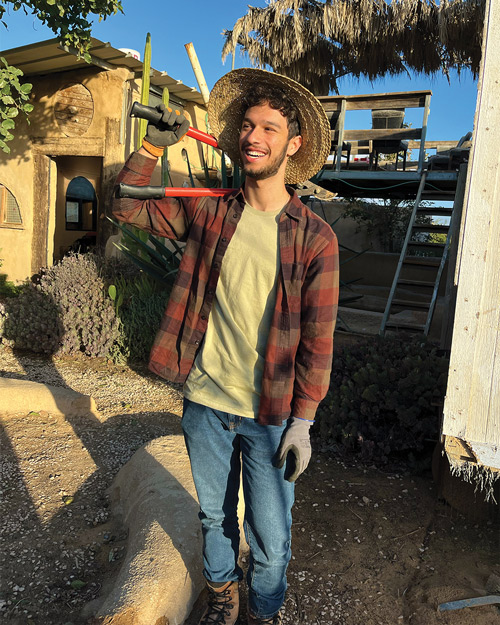
Tovar Stein volunteered in Israel after October 7.
PHOTO COURTESY OF TOVAR STEIN
Tovar Stein
Growing up in the Washington, D.C., area, Tovar Stein eagerly awaited his new PJ Library book each month. So when he moved to Singapore with his family during high school and his mother volunteered to coordinate PJ Library for their new community, Tovar took pride in helping deliver books to young children. He also used the books as teaching tools for second and third graders at the local religious school, relishing the chance to share the same experience with them that had brought him so much joy.
“I remembered how PJ Library impacted me as a kid. It normalized my Jewish upbringing. Reading the books, they were always about people like me,” Tovar recalls. “Getting to read kids PJ Library books at the Sunday school was really special to me. The Jewish community in Singapore is pretty small, and I wanted the kids to be able to have the same experience that I did.”
Since then, Tovar’s connection to Jewish life has only grown stronger — and has changed his life in ways he didn’t expect.
After high school, Tovar embarked on an immersive gap-year program in Israel. But six weeks into the program, everything changed when he awoke to sirens the day of the October 7 attacks. Rather than return home, Tovar realized he could make a difference as a volunteer. “I volunteered to pick tomatoes and olives on a farm, sort goods at a food bank, and later spent almost a month in a hotel kitchen as a sous chef,” cooking for Israelis displaced from their homes, he says. Back home, he enrolled in an EMT course, training to save lives — and switched his college major to premed, hoping to specialize in disaster relief.
Now 21 and a junior at the University of Florida, Tovar is involved in Jewish life through Hillel. As president of Challah for Hunger on campus, he helps run challah-baking events for fellow students; the group donates proceeds to regional food banks and charities. “Being involved with Jewish life in college is extremely important to me, given the climate on college campuses right now,” he says. “Doing Jewish activities and bringing good into the world through them helps remind me that those who hate us do not define who we are.”
Looking back, Tovar appreciates the early Jewish memories that helped shape his outlook. “PJ Library helped me become the person and the Jew that I am today,” he says.
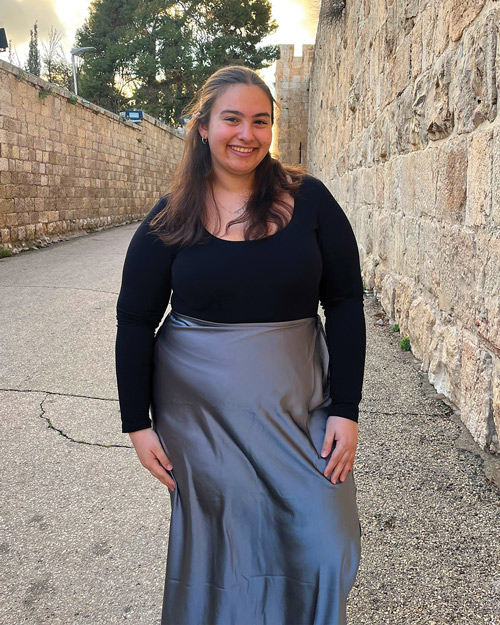
Jordana Goldstein bonded with peers over PJ Library books.
PHOTO COURTESY OF JORDANA GOLDSTEIN
Jordana Goldstein
Jordana Goldstein was traveling across the US on a bus with dozens of other Jewish teens after her freshman year of high school — through the USY on Wheels youth group experience — when she realized she and her new friends shared a profound connection. “Can you raise your hand if you received PJ Library books as a kid?” she asked. Nearly all the teens on the bus raised their hands.
Now 19 and a sophomore at Dickinson College, Jordana still grins as she remembers the way she bonded with fellow program participants over favorite childhood stories. “I was talking about one of my favorite books, about different ways to eat matzah brei, and one of my friends knew exactly which book I was talking about,” she recalls. “Knowing that a lot of my peers grew up with the same books I had read, it created a sense of community. We’d already had this Jewish experience in common before I even met them.”
For Jordana, that experience began when she was a young child growing up in New Jersey. “I remember this sense of excitement every time a new book would arrive. I would open it and sit down immediately to read it with my mom,” she says. “PJ Library showed me that it’s possible to see myself in a book.”
In her tween years, PJ Our Way deepened that Jewish connection and served as a bridge to other Jewish opportunities in high school. She took part in United Synagogue Youth, Jewish Student Union, and the Diller Teen Fellows program, a yearlong Jewish leadership cohort.
The impact of PJ Library still resonates for Jordana today.
“PJ Library definitely helped set me up for future Jewish engagement,” she shares. “PJ Library helped build a sense of Jewish connection from the moment I started receiving books. Having good Jewish role models in books growing up created a sense of pride and belonging. It helped shape who I am and inspired a passion to be involved with my Jewish community.”
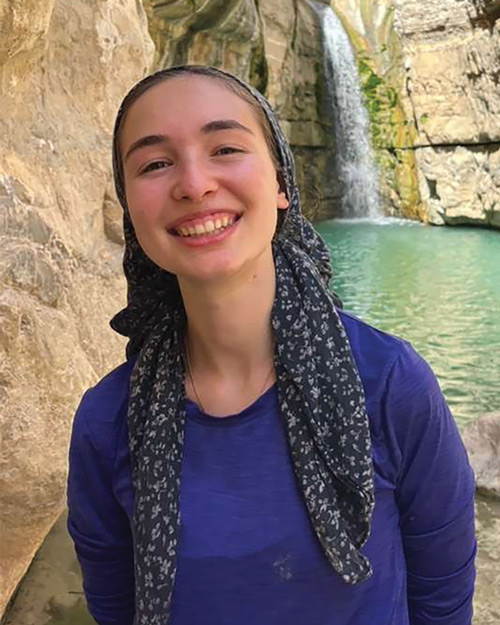
Hannah Plotkin teaches Torah study to women.
PHOTO COURTESY OF HANNAH PLOTKIN
Hannah Plotkin
Hannah Plotkin smiles as she recalls telling her parents about new things she learned in books as a child — concepts like tikkun olam (repairing the world) or tzedakah (charitable giving). That’s because the books that surrounded Hannah and her sister as they grew up in Cleveland, the books they read together and requested for bedtime stories, were PJ Library books.
“I grew up with a huge love of reading, which was fostered by PJ Library and PJ Our Way,” she says. “When I think about favorite stories, I don’t think about Little Red Riding Hood. I think about Sammy Spider and Rabbi Harvey and Chicken Man. Those are the characters of my childhood.”
Hannah, now 21 and living in Israel, has channeled her lifelong love of reading and learning into her work as a Jewish educator. And she says PJ Library planted the seed.
In middle school, Hannah loved choosing her own monthly chapter books and jumped at the chance to join the PJ Our Way Design Team — a rotating group of kids, selected through a competitive application process, who dream up creative ways to market the books to other tween readers. On the Design Team, she wrote book reviews, created blog posts, and filmed videos. She began to feel a sense of “ownership” over her Jewish identity, she recalls. And she eventually became the team leader, mentoring other young members as they developed their own book-related projects.
“Being the Design Team leader was my first experience with being a leader, and it gave me a lot of confidence,” Hannah says. “The opportunity to lead peers pushed me to learn to speak up and give direction and trust my judgment. It showed me that I have the ability to contribute meaningfully to my community.”
That early experience as a mentor fortified Hannah as she embarked on her teaching career. She now teaches advanced Torah study to women at two yeshivot (academies of traditional Jewish learning) in Jerusalem.
“PJ Our Way shaped my ability to translate deep Jewish ideas into language that’s accessible, engaging, and relevant to others,” Hannah says. “It helped me understand that Torah and Judaism can and should be taught in a way that empowers learners to think for themselves. That has given me clarity in my teaching and confidence in my ability to help other people connect meaningfully to Torah.”
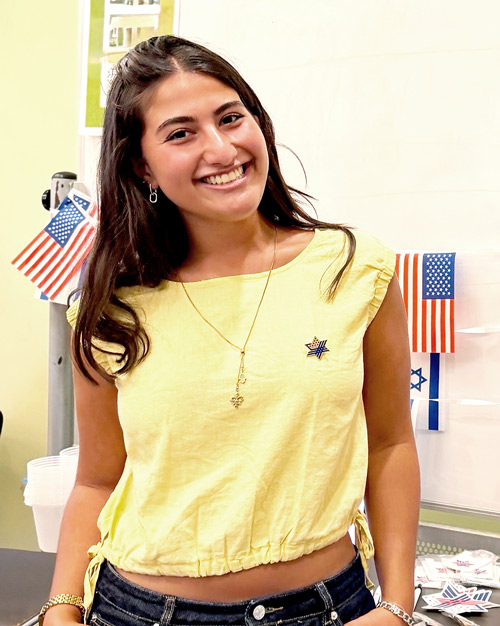
Pnina Sasson advocates for Jewish and Israeli students on campus.
PHOTO COURTESY OF PNINA SASSON
Pnina Sasson
Two weeks after the October 7 attacks, Pnina Sasson, then a college freshman, encountered a protest she couldn’t look away from. Scores of students and older adults had gathered near her campus at Tulane University, shouting anti-Israel and anti-Jewish slogans. “I didn’t plan on counterprotesting, but when you have to pass it to get to class, it’s harmful and distressing,” Pnina recalls. “There were people on the other side telling us to go to Auschwitz, saying ‘gas the Jews.’ My Jewish identity is so deeply rooted that I couldn’t just walk past it.”
Pnina and her fellow Jewish students engaged in a counterprotest that was peaceful at first. Then she and her friends saw two men try to light an Israeli flag on fire. One classmate rushed in to stop them; they beat him. Another man broke another friend’s nose.
Shaken by the experience, Pnina wondered what she could do. She reached out to her network of Jewish summer camp peers seeking media contacts and told the story to Jewish news outlets across the US. “From that,” she says, “I learned the importance of community — having a Jewish community that has your back.”
Pnina, now 21 and a college senior, has become a leader of the Jewish community at Tulane. She serves as president of TIPAC, the Tulane Israel Public Affairs Committee, and is an advisor for SSI, Students Supporting Israel. In these roles, she advocates for Jewish and Israeli students, helps bring attention to antisemitism on campus, and fosters dialogue between schoolmates. Her commitment to this work, she says, came from a warm Jewish childhood in which PJ Library was a cornerstone.
“Being Jewish in college right now forces you to choose one or the other: to hide or to be proud,” Pnina says. “That’s the main thing that PJ Library teaches us — to be proud Jews and not to hide. When you feel discouraged by all the hate, you hold onto those core memories from when you were young and remember your identity: Who are you? What messages do you keep close to your heart? The messages of Jewish pride that PJ Library books gave me as a kid have continued to stay with me.”
And she believes PJ Library is more important now than ever before. “What has gone on in the world over these past few years has been earthshaking,” she says. “We see what it’s doing to us as young adults, but we don’t yet know what it’s going to do to future generations. PJ Library books create a digestible way for kids to understand how to be proud of who you are as a Jewish person. Kids need that. The future needs it.”