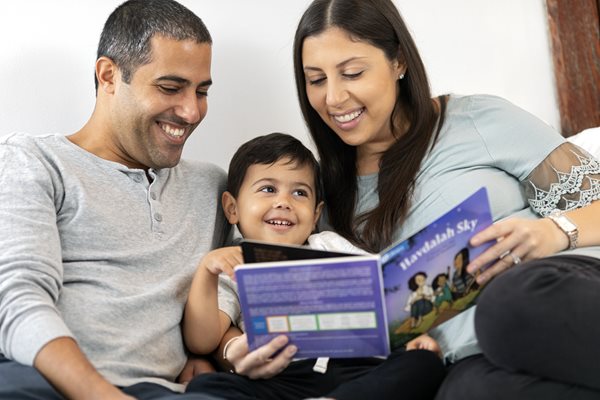
This is the second post in a series by Rabbi Laurie Matzkin designed for interfaith parents and mixed-heritage families raising Jewish children, exploring Jewish family life, or looking for accessible ways to bring Jewish stories, values, rituals, and questions into their homes. Interfaith and mixed-heritage families are central to the present and future of Jewish family life.
A PJ Library book can do two things at once. It can help your family see itself in a story, and it can help your family explore Jewish heritage together. For interfaith and mixed-heritage families, both matter.
Some books are mirrors. They reflect families with more than one background, language, culture, or family story. A child may recognize a grandparent, a holiday table, a food, a name, or a feeling. A parent may recognize that Jewish family life has many faces, histories, and pathways.
Other books are windows. They open into Jewish holidays, rituals, values, songs, foods, Hebrew words, and family conversations. A story about Shabbat can lead to lighting candles. A book about Sukkot can lead to welcoming guests or talking about what makes a home. A Hanukkah story can lead to questions about light, courage, family recipes, and how your household celebrates.
A core prayer and teaching is the Shema — “Hear, O Israel” — which Jews might say in synagogue, at bedtime, at other prayer times, and in moments of transition. The Shema is also embedded on a scroll inside the mezuzah, marking the windows of Jewish homes. It includes the commandment “v’shinantam l’vanecha” — often translated as “teach them diligently to your children.”
The Hebrew carries a sense of repetition: teach it again, say it again, return to it again. This is how Jewish words, questions, stories, and practices become part of family life. PJ Library supports that kind of returning. The books themselves are one entry point. The notes and conversation prompts on the front and back book flaps can help grown-ups find language, context, questions, and activities. The PJ Library website offers additional useful information in the form of holiday guides, book lists, podcasts, recipes, music, videos, and family-friendly explanations.
Some books may be especially meaningful for mixed-heritage families, including Mixed-Up Mooncakes (Jewish and Chinese; Sukkot and Mid-Autumn Festival), Queen of the Hanukkah Dosas (Jewish and Indian; Hanukkah foods), Nonna’s Hanukkah Surprise (Jewish and Italian Catholic extended families), Rebecca’s Journey Home (adoption, Jewish belonging, and Vietnamese birth heritage), Mazal Bueno! (Sephardic, Ladino, and Judeo-Spanish heritage), and We Are Jewish Faces (racial, cultural, and family diversity in Jewish life).
Your family may recognize itself in one story and find a useful question in another. Some families will find a mirror. Others will find a window into a conversation they have been wanting to have.
Open a book. Read together. Ask your child what they respond to. Use the book flaps. Follow a question. Try a recipe, song, blessing, or holiday activity. And when you return to the story next time, notice whether the mirror or window looks different to you or your child.
About the Author
Rabbi Laurie Matzkin is the Chief Jewish Experience Officer at the Peninsula Jewish Community Center in Foster City, California, and a Rukin Rabbinic Fellow with 18Doors. A former Family Educator for PJ Library in Silicon Valley, she loves helping families find language, stories, rituals, and questions that make Jewish life feel meaningful at home. A fifth-generation Bay Area native, Laurie lives with her husband, a local Jewish educator, and their two sons.
More
Lessons from a Multifaith Family
More for Interfaith Families
What the Term “Interfaith Family” Means via 18Doors
October 8, 2026