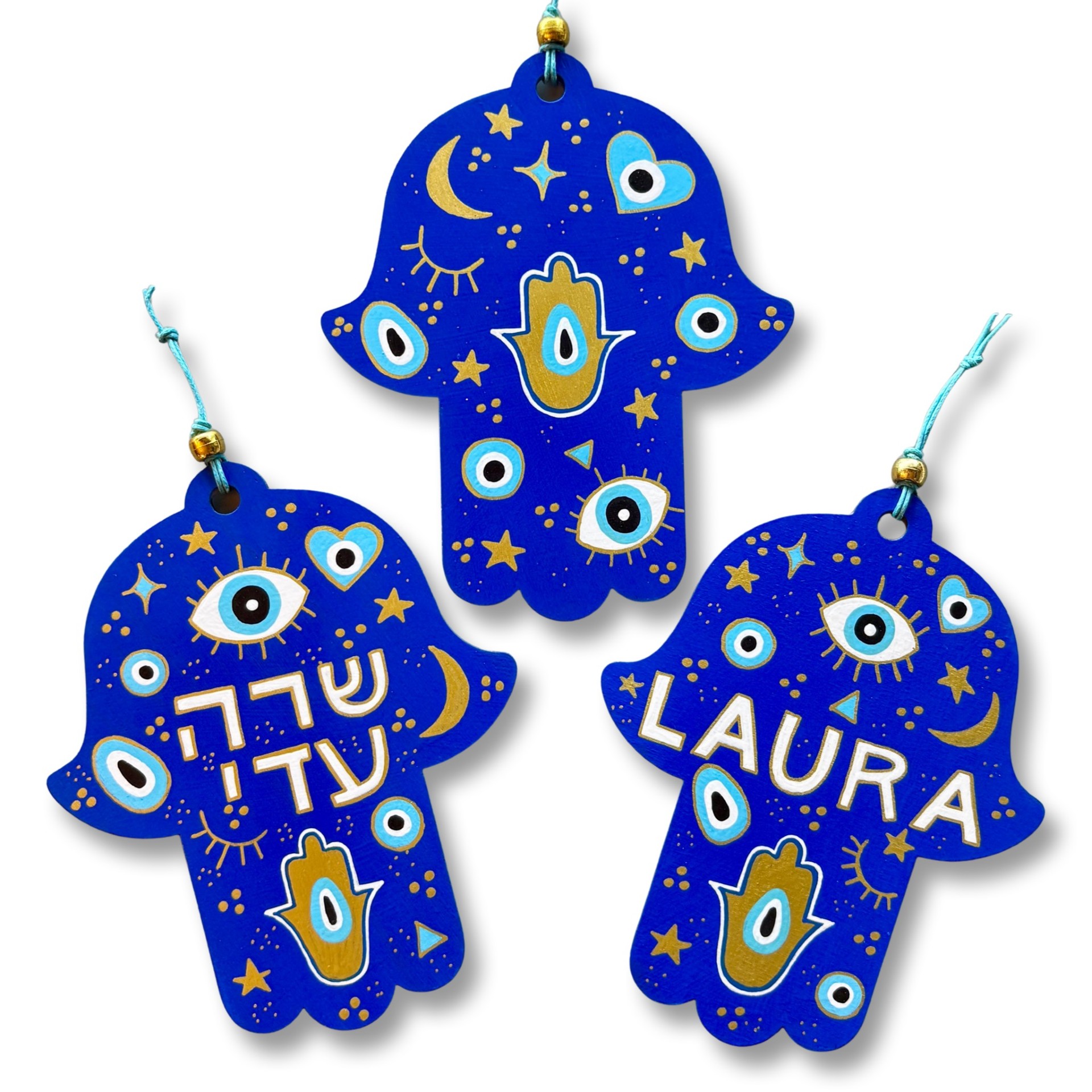
What is a hamsa?
A hamsa is a hand-shaped symbol with a long history in Jewish communities and other cultures across the Middle East and North Africa. It’s a familiar symbol in Jewish art and Judaica, but what does it mean, and where did it come from?
What does a hamsa look like?
The hamsa is shaped like an open hand with five fingers. In fact, hamsa is the Arabic word for “five.” A hamsa can be a piece of jewelry, an artwork, a decorative object, or an element in other pieces of folk or ritual art.
Hamsas can look very different from one another. Some have straight or curved fingers, while others are decorated with flowers, stars, patterns, or other symbols. The design often reflects the creativity and style of the person who made it. I love the good wishes and protection that a hamsa represents, especially when it is gifted to a child. It’s even more comforting and personal when it’s decorated with things that child loves—flowers, stars, cars, trucks, or their name. The same ancient symbol can look completely different and feel special for every family.
What does a hamsa mean?
The hamsa has different meanings across cultures and communities. In Jewish communities, it is often associated with protection and blessings. For many families, a hamsa is a meaningful symbolic object to display in their home or give to someone as a token of good wishes. It also is valued because it connects contemporary Jewish life with the history and traditions of Jewish communities from different parts of the world.
Some hamsas have an eye in the center. The eye is connected to the ancient belief of the “evil eye,” the idea that directing one’s jealousy or negative thoughts toward someone brings them bad luck. This belief exists across many cultures. In Jewish and other cultures, the hamsa and eye have been used as protection from the evil eye.
The hamsa has a long history and has been used by different cultures across the Middle East and North Africa. Jewish communities from those parts of the world made the hamsa part of their art and traditions. One of the coolest things about the hamsa is that it appears as a symbol in belief systems and cultures around the world: Jews, Muslims, Christians, and others all use it.
About the Author
Jenni Arielly is the owner of LeaJoelleHandmade, a small business creating beautiful, custom Judaica for families around the world. From colorful hamsas and personalized mezuzah cases to other special pieces, each creation brings personality and artistry to Jewish traditions. Learn more at LeaJoelleHandmade.
Jenni adds: At LeaJoelleHandmade, we are honored to be part of these meaningful milestones and everyday traditions. Through our 2026 partnership with PJ Library, every children’s order will include a PJ Library book, giving families a way to celebrate Jewish traditions through both meaningful rituals and the joy of Jewish storytelling.
More
An Introduction to Mizrahi Culture
The Hamsa in Jewish Though and Practice via The Times of Israel
November 9, 2026