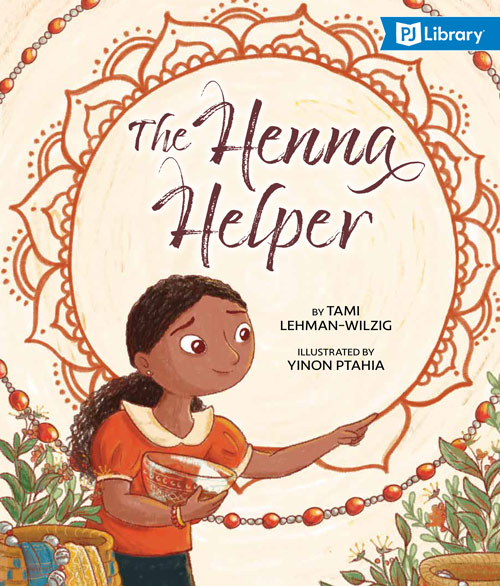
What is the power of a blessing? In The Henna Helper, written by Tami Lehman-Wilzig and illustrated by Yinon Ptahia, readers follow Gali, the main character, as she connects with the deep-rooted traditions of her Yemenite Jewish heritage. Silversmithing and jewelry-making are time-honored Yemenite Jewish crafts, with pieces often featuring ornate filigree and precious stones. Through the story, readers also see special traditional Yemenite Jewish clothing, customs, food and, of course, the role of the henna ceremony.
Take a book-look, discuss the story, learn more about henna, try traditional Yemenite Jewish recipes, explore videos, and more in the sections below:
Look
Take a look at the illustrations in the story:
- Do you see the maizar or futa (a wraparound skirt worn with a tunic), the traditional garments worn by men?
- What do you notice about the kippot you see?
- Check out the decorative borders!
- The beautiful headdress that Savta makes for Yael is called the gargush.
- Savta mentions several communities that wear these special pieces for weddings — do you remember who they are?
- Does Gali’s neighborhood look like yours? Does it seem different?
- How so?
- What are the neighbors doing to get ready for Yael’s wedding?
- What are some of the special things that you notice happen at the henna party?
Discuss
- At the beginning of the story, why is Gali feeling grumpy and upset?
- If you went to a henna party, which part do you think you’d like the most?
- What do you see in Savta’s sewing room?
- What does this room tell you about Savta?
- Does your family have any special ways of celebrating weddings?
Learn
The henna used in ceremonies like Yael’s is made from the leaves of the henna plant, which are dried and ground up, then made into a paste by adding water or oil. The result is a rich reddish-brown dye, and the designs that skilled henna artists make with it on the skin are simply stunning!
The color, smell, and feel of the henna on the skin combine into a powerful sensory experience: a real, tangible blessing to the bride and groom before they begin their life together. Henna isn’t the only blessing they receive, though. The ceremony also includes festive baskets filled with lit candles to bring the couple a blessing for joy and light, as well as decorated eggs for the blessing of fertility and good fortune. A Jewish henna ceremony is a rich experience! (You can watch a video of a henna ceremony in the “Watch” section below).
Do
- Try some Yemenite Jewish food like jachnun (a savory-sweet pastry), kubaneh (pull-apart bread), malawach (a flatbread), zhug (a hot sauce), or marak regel (a savory soup).
- At first Gali isn’t so sure about the henna party or traditional dresses, but she learns from Savta about the power of l’dor vador — the transmission of customs and knowledge from generation to generation — and really gets into it. Talk about some of the traditions you have created or shared in your own family or community.
Watch
Check out these videos from The Mizrahi Story on Instagram to learn more about Yemenite clothing, watch a Jewish henna wedding ceremony (like the one depicted in the book), and learn about the art of Yemenite silversmithing:
Clothing
Henna Ceremony
Silversmithing
More
Stories that Feature International Jewish Foods
The Secret Jewish Kingdom of Yemen via Unpacked Media
The History of Operation Magic Carpet via Alaska Airlines
June 4, 2026